
The History of DNA Paternity Testing
DNA-based lineage tests (paternity, maternity, sibling, grandparent–grandchild and other tests) today represent the most accurate and most effective way of mapping kinship relationships and descent.

Today's modern DNA-based tests approach 100% certainty, meaning that according to current knowledge they reflect biological reality (that is, they are unambiguously capable of confirming or excluding the existence of a blood relationship between two people).
Lineage tests have not always been this conclusive. Before DNA tests came into use, other biological methods were employed. These techniques (blood group typing, serological tests, HLA testing) are still used today with great benefit and effectiveness in many other fields: for example, these methods help match donor blood, tissues, and organs with the most suitable recipient, thereby reducing the rate of rejection reactions in transplant patients; however, over the past few decades, far more suitable methods have been developed for examining genetic relationships.
The first wave of development and introduction of DNA-based methods took place in the late 1970s and early 1980s — from this point onward, experts were able to identify and determine biological relationships much more efficiently and accurately. With the help of DNA-based lineage tests, today we can unambiguously determine the identity of individuals and their biological relatives, as well as their biological relationship (paternity, maternity, sibling relationship, blood kinship).
Below is a brief overview of the history of lineage testing, from blood group testing to the latest techniques in DNA-based testing.
The 1920s: Blood Group Testing
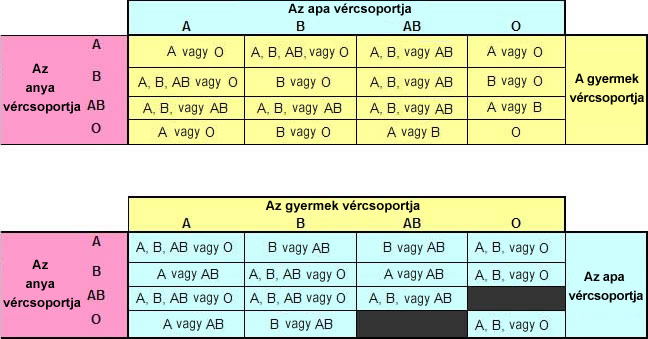
In the early 1920s, scientists knew of 4 different blood groups: A, AB, B, and O — these were the names given to the blood groups defined by the presence or absence of proteins on the surface of red blood cells. The use of the so-called ABO blood group system greatly helped practicing physicians develop the technique of safe blood transfusion.
Since blood groups are inherited biologically, according to the rules of inheritance we are able to predict a child's blood group based on the blood groups of the biological parents. This technique has many limitations — in certain cases it was difficult to clearly confirm or exclude a biological relationship: if the child has type A blood and the child's mother has type AB blood, then the child's biological father could be any one of the 4 blood groups. Thus, in this example, no one's biological paternity can be excluded — and the test may therefore be inconclusive in such a case. A test result excluding paternity based on ABO blood group testing has approximately 30% effectiveness — it cannot be used for routine paternity testing.
The 1930s: Serological Testing
In the 1930s, scientists discovered additional proteins on the surface of blood cells — these too are suitable for identifying individuals. The Rh, Kell, and Duffy blood group systems, similar to the ABO blood group system, follow biological inheritance patterns and, together with the already known ABO blood group system, provided further information for analyzing the biological relationships in question. However, serological tests still did not provide reassuringly accurate results: the power of exclusion in serological tests is around 40%, which means that this technique alone is still not effective enough to clarify lineage-related legal questions.
The 1970s: HLA-Based Testing
In the mid-1970s, research uncovered a unique system based on the surface protein components of tissue types, which was named the human leukocyte antigen (HLA) system. An important characteristic of this system is that the cell-surface proteins are found on the surface of every cell of the body (except red blood cells). The characteristic HLA content is found in large quantities on the surface of white blood cells in the blood. As a result of these investigations, several HLA structures were identified — and the HLA structures of biologically unrelated individuals are very different from one another. Due to the high degree of variability in HLA types, the HLA system became usable for mapping potential biological relationships, and was thus also applied to lineage (paternity) testing. Paternity exclusion based on HLA testing has 80% effectiveness, and when combined with ABO blood group testing and serological testing, it can reach as much as 90% effectiveness. As a consequence of this efficiency rate, the number of laboratory paternity tests increased significantly. Today, however, paternity testing based on the HLA, ABO, and serological methods is no longer in use and can be considered obsolete, primarily because complicated, cumbersome, and careful sample collection is required — a large amount of blood was needed to perform the test, and for ethical reasons this is not acceptable in children.
The 1980s: DNA Testing with RFLP Technology
In the early 1980s, the technology described by the English name Restriction Fragment Length Polymorphism (RFLP) was developed, which was the first DNA-based genetic test. Similar to the previously discussed HLA, ABO, and serological tests, our DNA is also inherited, coming from both biological parents. In the structure of DNA molecules, regions were discovered that have highly variable lengths ("polymorphic") and are more suitable for distinguishing individuals than the earlier procedures. DNA is found in every nucleated cell of the body (which is why it is not present in red blood cells, since they lose their nucleus during the final stage of their development). In the RFLP procedure, the testing laboratory uses enzymes (restriction endonucleases) to size DNA and labeled DNA probes, and to identify regions containing VNTRs (Variable Number Tandem Repeats). During paternity testing (when DNA samples from the mother, child, and alleged father are tested), half of the child's DNA must match the mother's DNA and half must match the father's DNA. It can happen that the child's DNA profile does not match the parents' at a single DNA location (locus), the cause of which may also be a mutation. The presence or exclusion of mutation can be determined by mathematical and population-analytical methods. The exclusion power of RFLP DNA-based paternity testing is greater than 99.99%. Today, however, this type of test is no longer performed either, as the test itself requires a large amount of DNA (about 1 microgram), and providing this involves much inconvenience (the sample collection process is complex), and the testing time was also long (10–14 days).
The 1990s: PCR DNA Testing
From the early 1990s, DNA testing using the then-discovered polymerase chain reaction (PCR) replaced the previously introduced RFLP analysis in routine lineage testing. PCR analysis requires far less DNA (1 nanogram), so it can be performed from an oral mucosa epithelial cell sample (a "saliva sample"); this means blood collection is no longer necessary, and on the other hand, PCR testing is completed more quickly. The aim of the PCR procedure is the comparative examination of DNA regions known as STRs (Short Tandem Repeats), which are highly variable. During paternity testing, when the mother, child, and alleged father are tested, the child's DNA must show identity with both biological parents (except in the case of mutation). Statistical calculations can confirm or exclude the presence of mutation. Sometimes two or three genetic differences may also be observed — in such cases, additional confirmatory testing may be necessary.
For paternity testing, DNS Központ examines the STR values of individuals at internationally accepted, standardized chromosomal locations (loci), but in special situations may also test additional (non-standard) STR locations. The effectiveness of PCR-based DNA testing exceeds 99.99%.
The 2000s: Examination of SNP Layers
With the technology available since the early 2000s, the combined examination of several thousand SNP (Single Nucleotide Polymorphism) loci can be carried out in a single test. SNPs are characteristic features of DNA that can also be used as genetic markers for various testing purposes. SNP determinations are not primarily suitable for examining family biological relationships, but are performed for the purposes of numerous other genetic investigations: thus they are mainly used for analyses related to genetic diseases, healthy lifestyle, and the examination of historical-ethnic ancestry.
The database also contains AIM data (Ancestry Informative Markers) — including Y-chromosome markers, mitochondrial markers, and ancient DNA markers, which are also suitable for examining distant biological relationships (for example, for verifying the connection of 4th- or 5th-degree cousins).
The 2010s: The NGS Method (Next Generation Sequencing)
NGS (Next Generation Sequencing) or so-called massively parallel sequencing is the latest genetic analysis technology. During this procedure, the testing system creates a DNA sequence that consists of a linear arrangement of the nucleotides (A, T, C, and G) present in a DNA sample. With this technology, sequencing of the molecule is initiated at thousands of locations on overlapping DNA molecule fragments, and the resulting data is analyzed with high-performance computer programs to assemble the precise base sequence of the DNA molecule. DNS Központ currently uses this NGS technology for the so-called Non-Invasive Prenatal Paternity (NIPP) test, which can determine the biological father of the fetus from a blood sample taken from the mother as early as after the 8th week of pregnancy. Prenatal paternity testing existed earlier as well, but it required invasive sample collection: amniocentesis or chorionic villus biopsy. The NIPP test used today does not endanger the health of either the fetus or the mother, and is able to safely and accurately establish — or exclude — the biological paternity of the alleged father being tested. During the test, cell-free fetal DNA (cfDNA) isolated from the maternal blood is examined — using the applied NGS technique, the exclusion or confirmation of paternity is based on the verification of several thousand SNPs. This method has all the necessary regulatory approvals, and confirmatory verification of the obtained result after birth is not required.