• Frequently asked questions
  • Glossary
  • Knowledge Base

Call us +36-20/373-5580

 | Sign Up
Dnskozpont.hu
Dnskozpont.hu
Menu
  • Family relationship testing
  • Webshop
  • About Us, Contact
  • Price list
  • Accuracy of DNA Testing
  • Sample report format
  • Sample types accepted for paternity testing
  1. Home
  1. Home
  2. Knowledge Base

Knowledge Base

Gene Therapy and the Future of Genetic Research: How Science Is Shaping Our Everyday Lives

Gene Therapy and the Future of Genetic Research: How Science Is Shaping Our Everyday Lives

Among the most exciting questions of science is this: how far can the hand of humanity reach in shaping its own fate? Gene therapy and genetic research are today opening doors that, only a few decades ago, we could find examples of only on the pages of science-fiction novels. Humanity has long sought to decipher what is encoded in every single cell of our bodies. Now, however, we not only understand this code — we are also capable of writing it. This ability brings revolutionary consequences with it, and may transform our daily lives to the same extent as agriculture or the industrial revolution did in their time.

Imagine a future in which prenatal genetic tests make it possible for children not only to be healthy, but to receive an optimized set of genes for a long and productive life. Or think of today, when genetic-based medicine is already able to halt certain hereditary diseases, and soon, perhaps, we may even fully defeat cancer. But what price will we pay for all of this? And does this road truly lead to humanity's happiness?

As with all new technologies, gene editing too raises questions that are difficult to answer unambiguously. CRISPR technology, for instance, is not merely a scientific tool, but the very key to reshaping life itself. In our article we will not only explore how this technology works, but also examine how it is changing healthcare, society, and our everyday lives. The future is already here — but are we ready for it?


Details
On the Trail of Genetic Clues: The Revolution of DNA Analysis in Law Enforcement

On the Trail of Genetic Clues: The Revolution of DNA Analysis in Law Enforcement

Imagine a medieval investigator trying to find evidence at the scene of a murder — at best, they could rely on the testimony of an eyewitness or a dropped cloak button. Today, however, the perpetrator's identifier is hidden within a single hair or a single drop of blood, even if no one saw the offender. The history of law enforcement was transformed by a revolutionary leap brought by DNA analysis, which serves as a molecular fingerprint for every person. This technology not only puts cold-blooded killers behind bars, but is also capable of exonerating the innocent, while at the same time raising serious ethical questions about data protection and the limits of privacy. How did we get here, and where is the revolution of genetic clues in criminology heading? In what follows, we will examine the role of DNA analysis in law enforcement through historical and modern criminal cases, as well as broader societal reflections.

Details
The History of Genetic Research: From the Discovery of DNA to the Present Day

The History of Genetic Research: From the Discovery of DNA to the Present Day

Through genetic research, humanity has done something unprecedented in the history of evolution: it has not only observed, but has sought to understand and shape itself at the most fundamental level. With the discovery of DNA and the advancement of genetic research, we have uncovered the workings of the molecules that form the basis of life, thereby gaining insight into our own deepest origins. For the first time in human history, we have become capable of intervening in our own genetic material — the code that has been shaped over millions of years, and that carries the genetic heritage of every human, plant, and animal. Yet as the secrets of DNA gradually unfold before us, questions also arise that cast an ever sharper light on the fragility of human existence, and indeed, on our own limits.

This new level of science may be capable not only of transforming human health, but also of altering the fundamental order of nature. For the first time, humanity is beginning to understand the consequences of taking its evolutionary future into its own hands. The question, however, is this: are we prepared to understand and responsibly handle this power? Because with the unveiling of DNA, not only has a new scientific era begun, but also a philosophical one — an era in which we must confront our own limits and decide what role we wish to play in shaping our own genetic heritage.

Details
The History of DNA Paternity Testing

The History of DNA Paternity Testing

DNA-based lineage tests (paternity, maternity, sibling, grandparent–grandchild and other tests) today represent the most accurate and most effective way of mapping kinship relationships and descent.

Details
A Brief Overview of the Grandparent–Grandchild DNA-Based Lineage Test

A Brief Overview of the Grandparent–Grandchild DNA-Based Lineage Test

Establishing biological paternity can sometimes be a complex matter, and it is often a much more difficult task than it sounds. It may happen that the alleged father is simply unavailable for some reason — his DNA sample cannot be tested. In such cases, a possible alternative is the grandparent–grandchild DNA test, which can clarify the biological relationship between the child and the grandparents on the alleged father's side, thereby making it possible to identify the child's biological father.

Details
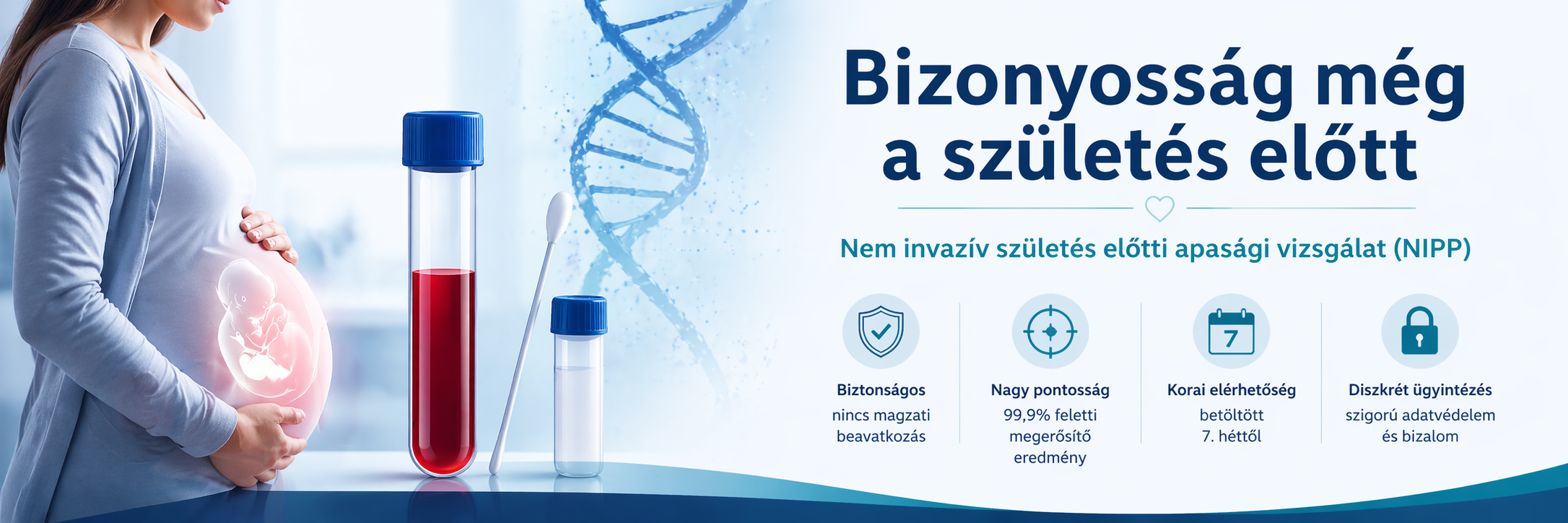
Non-Invasive Prenatal Paternity Test – Complete Guide

Non-Invasive Prenatal Paternity Test – Complete Guide

When a positive pregnancy test brings not only joy but also uncertainty, time suddenly slows down. Behind the everyday questions lingers a sentence that is harder to say out loud: who is the child's biological father. This is not merely an emotional burden. It can affect decisions within the relationship, communication within the family, future legal steps, and how peacefully the parents can prepare for the child's arrival. Modern paternity tests have become important precisely because this uncertainty can now be replaced not with guesswork, but with objective genetic data.

The role of modern genetics here can be summarised simply: it does not speculate, it compares. Based on the foetal DNA fragments circulating in the expectant mother's blood and the DNA of the alleged father, laboratory methods can determine with high certainty whether a biological relationship exists. The principle of the technology is the same as in any DNA-based kinship test: it looks for matches in inherited genetic patterns — only in this case, before birth.

This article will guide you through how the non-invasive prenatal paternity test (NIPP for short) works, when it is recommended, how accurate it is, how much it costs, and what the result means in everyday life, as well as in any subsequent official procedure.

Details
DNA-based paternity test — what it can help with, and what it can't

DNA-based paternity test — what it can help with, and what it can't

With today's advanced technology, you can be confident that the test will give you a precise and definitive answer to the question of paternity — especially if you have it carried out in a reliably operating, regularly audited, and highly accredited laboratory.

Details
Sample types accepted for paternity testing

Sample types accepted for paternity testing

A paternity test often clarifies important questions — for example in family matters or legal proceedings. Many people, however, are not sure exactly what kind of sample is needed for such a test, or what the court or other official authority will accept. In this article we explain, simply and clearly, what samples a paternity test can be made from, and how you can order them.

Details

Have a question? +36-20/373-5580

Subscribe to our newsletter!

Be among the first to receive the most important updates - just click the subscribe button to sign up for notifications!

Dnskozpont.hu
Logo
Customer account
  • Sign In
  • Sign Up
  • My Profile
  • Modify Data
  • Cart
  • My Favorites


Terms and Conditions
  • Terms and Conditions
  • Privacy Policy
  • Payment
  • Shipping
  • Legal Notice
  • Contact


Customer Service
  • info@dnskozpont.hu
  • +36-20/373-5580
  • 1133 Budapest, Vág Street 13., entrance directly from the street,
  • Open: Tuesdays 10:00 - 16:00,
  • Appointment required in advance!


Useful
  • Webshop
  • Family Relationship Testing
  • Accuracy of the DNA Test
  • What the Report Looks Like
  • Frequently Asked Questions
  • About Us


Featured Partners
Dr Bezzegh Szakértő iroda
Microbiome Bank
Eurofins Forensik
AlphaBiolabs
A2gen laboratórium
Dr Bezzegh Szakértő iroda
Microbiome Bank
Eurofins Forensik
AlphaBiolabs
A2gen laboratórium

Copyright © 2026 Webdesign, Dnskozpont.hu Dr. Bezzegh Szakértő Iroda Kft. - All rights reserved!

Dnskozpont.hu Made with ❤ by Webmaister
  • Family relationship testing
  • Webshop
  • About Us, Contact
  • Price list
  • Accuracy of DNA Testing
  • Sample report format
  • Sample types accepted for paternity testing
  • Frequently asked questions
  • Glossary
  • Knowledge Base
Customer account
  • Sign In
  • Sign Up
  • My Profile
  • Modify Data
  • Cart
  • My Favorites


Change language
  • hu
  • en
Sign in
Sign Up
Privacy settings
Our website uses cookies necessary for basic functionality. You can allow additional cookies for broader features (marketing, analytics, personalization). For more details, see our Privacy Policy in the Privacy Notice.
Essential cookies are critical for the website’s core functions, and the site will not work properly without them. These cookies do not store personally identifiable information.
We use marketing cookies to track visitors’ activity on the site. The goal is to show relevant ads to individual users (e.g., via Google Ads and Facebook Ads) and encourage engagement, making our website more valuable.
Statistical cookies help the website owner understand how visitors interact with the site by collecting and reporting data anonymously.
Personalization cookies let us remember information that changes how the website behaves or looks.