
Non-Invasive Prenatal Paternity Test – Complete Guide
When a positive pregnancy test brings not only joy but also uncertainty, time suddenly slows down. Behind the everyday questions lingers a sentence that is harder to say out loud: who is the child's biological father. This is not merely an emotional burden. It can affect decisions within the relationship, communication within the family, future legal steps, and how peacefully the parents can prepare for the child's arrival. Modern paternity tests have become important precisely because this uncertainty can now be replaced not with guesswork, but with objective genetic data.
The role of modern genetics here can be summarised simply: it does not speculate, it compares. Based on the foetal DNA fragments circulating in the expectant mother's blood and the DNA of the alleged father, laboratory methods can determine with high certainty whether a biological relationship exists. The principle of the technology is the same as in any DNA-based kinship test: it looks for matches in inherited genetic patterns — only in this case, before birth.
This article will guide you through how the non-invasive prenatal paternity test (NIPP for short) works, when it is recommended, how accurate it is, how much it costs, and what the result means in everyday life, as well as in any subsequent official procedure.
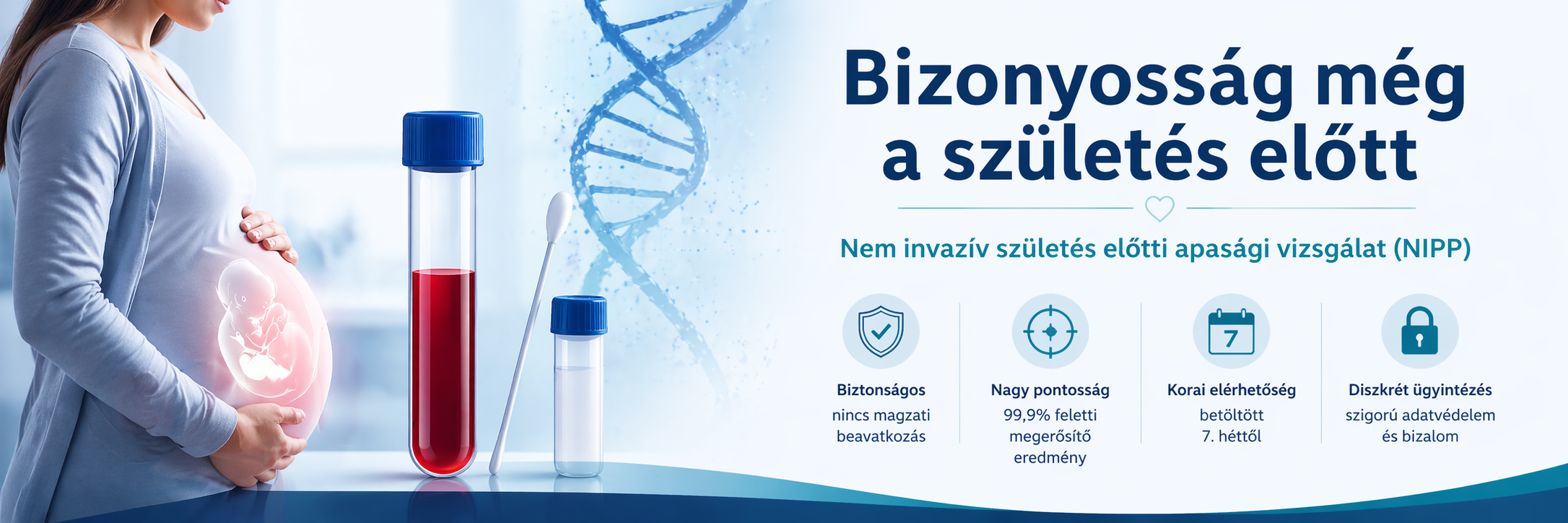
What is a prenatal paternity test
A prenatal paternity test is a genetic examination that analyses the biological relationship between the foetus and the alleged father during pregnancy. The method requires a blood sample from the mother and a buccal (cheek swab) sample from the alleged father. No foetal sampling – meaning no intrauterine intervention – takes place. This is the essence of the term non-invasive: the test does not take a sample directly from the foetus, but uses the foetal DNA fragments present in the mother's blood.
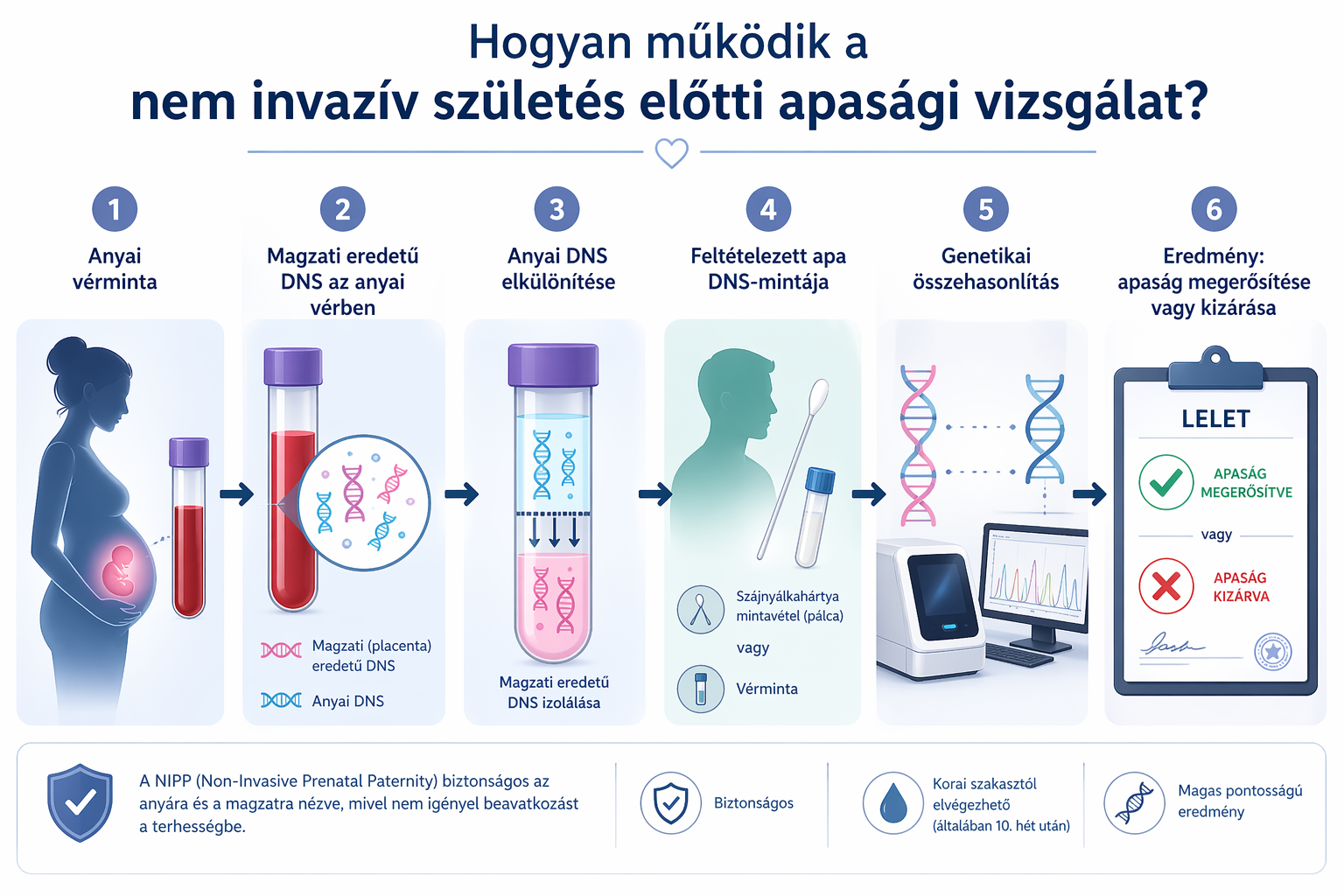
In a postnatal paternity test, the DNA of the newborn child is compared directly with that of the alleged father, typically from a buccal sample. In a prenatal test, by contrast, the laboratory has to "listen out for" the foetal genetic signal in a mixed sample: the mother's own cell-free DNA and the foetal-origin DNA are present together in the maternal blood. This makes the prenatal paternity test technically more complex, but thanks to modern next-generation sequencing (NGS) methods, it can now be performed routinely.
Invasive and non-invasive methods
Previously, prenatal genetic information was typically obtained through invasive procedures: chorionic villus sampling (CVS) or amniocentesis. CVS involves taking a sample from the placenta, generally between weeks 11 and 14; amniocentesis involves sampling the amniotic fluid, usually between weeks 15 and 20. These tests are very useful for medical diagnostic purposes – for example, in detecting chromosomal abnormalities or hereditary diseases – but both involve a needle puncture and carry a small but real risk of miscarriage.
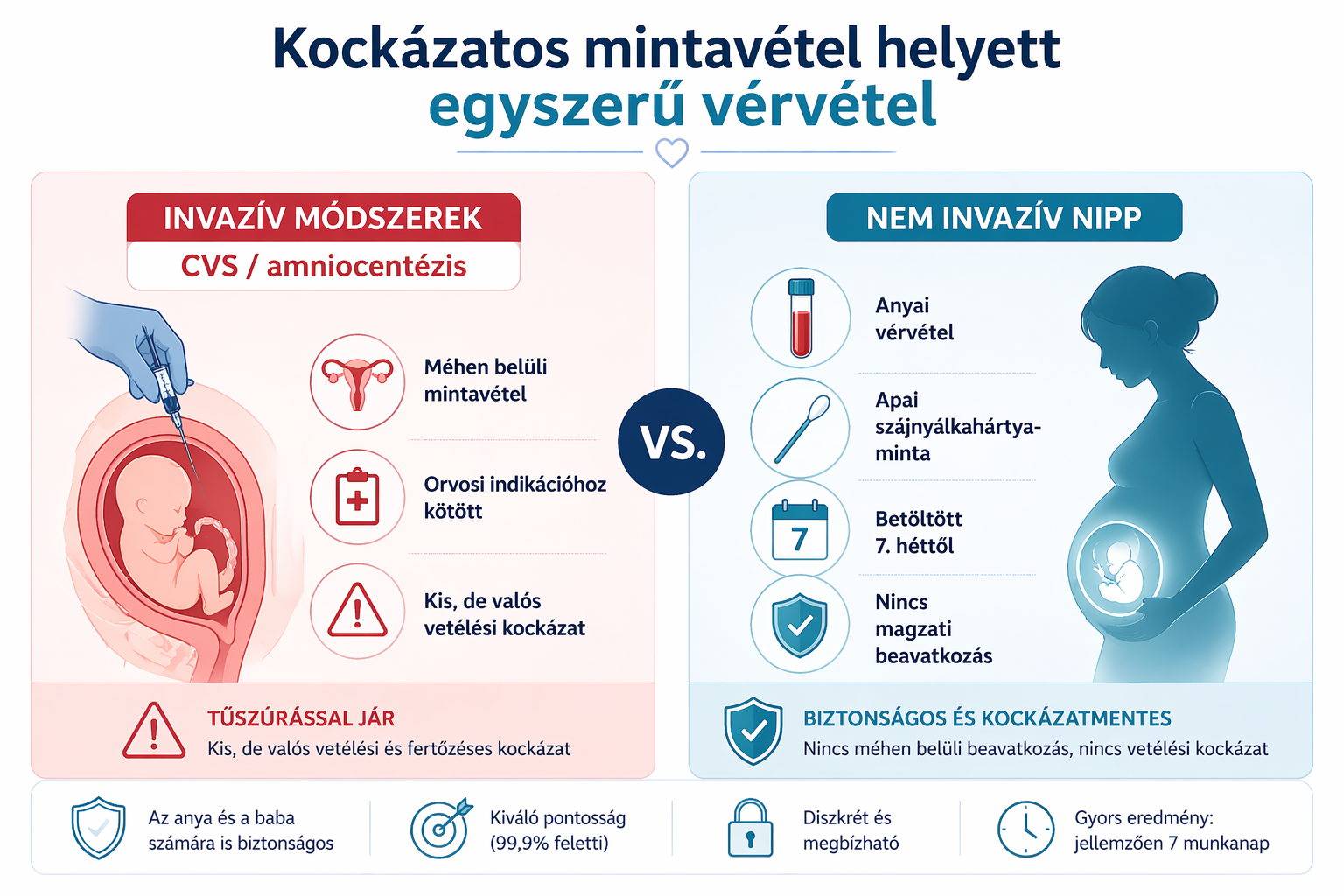
The non-invasive paternity test avoids precisely this risk. A standard blood draw from the mother and two buccal swab samples – that is the entire sampling procedure. The procedure is no different from a routine blood draw and poses no obstetric risk to either mother or baby.
The two approaches in brief:
| Aspect | Invasive (CVS, amniocentesis) | Non-invasive (NIPP) |
|---|---|---|
| Sampling method | intrauterine needle, from amniotic fluid or placenta | maternal blood draw + buccal swab sampling |
| Gestational week | CVS weeks 11–14, amnio weeks 15–20 | from the completed 7th week |
| Risk of miscarriage | small but real | no procedure-related risk |
| Additional purposes | chromosomal diagnostics, screening for hereditary diseases | establishing or excluding paternity |
| Recommended for paternity questions | today rarely justified for paternity purposes alone | this is the standard solution for prenatal paternity testing |
How the non-invasive test works
The key to the method is cffDNA – cell-free foetal DNA circulating in the expectant mother's blood. The phenomenon was described in maternal plasma in 1997, opening the door to non-invasive prenatal genetic testing. An important clarification: this DNA originates predominantly from trophoblast cells of the placenta and enters the maternal circulation from there, but it carries information about the foetus's genetic makeup. Its quantity – the so-called foetal fraction – increases as pregnancy progresses, which is why proper timing is particularly important in early testing.
The sampling procedure
From the outside, the process is simple: a blood sample is taken from the mother, because this is where the foetal-origin DNA needed for the test can be found. In addition, a buccal swab sample is taken from the mother as well, so that the laboratory can accurately determine the mother's own genetic profile and better separate it from what comes from the foetus. A buccal swab sample is also taken from the alleged father, typically using a sterile, individually packaged swab that is rubbed along the inside of the cheek inside the mouth.
The real work then takes place in the laboratory. The lab does not look for a single "paternity gene", because no such thing exists. Instead, it compares hundreds of genetic points – genetic variants, also known as SNPs and STR markers – simultaneously. Next-generation sequencing (NGS) is particularly well suited to extracting sufficient information even from the small and fragmented foetal DNA. A validated panel described in a 2023 publication, for example, analysed 861 genetic variants simultaneously and, on the basis of the combined paternity index, clearly distinguished the true biological father from unrelated men.
To put it simply: the lab works as if it were separating the "voices" of the mother, the foetus and the alleged father from a three-speaker, overlapping audio recording, and then checking whether the inheritance pattern expected from the father is indeed present in the child. If it matches at thousands of different "voice points" – including those where chance coincidence is virtually impossible – then biological paternity is, in genetic terms, confirmed.
Why one or two genetic markers are not enough
A paternity test is not a question of one or two markers. The more independent genetic points the lab compares, the greater the statistical certainty becomes. This multiple, parallel comparison is the reason why modern NIPP tests can confirm a biological relationship with a probability greater than 99.9% in the case of confirmation, and exclude paternity with practically 100% certainty when the man tested cannot be the biological father.
When can the test be performed – the question of timing
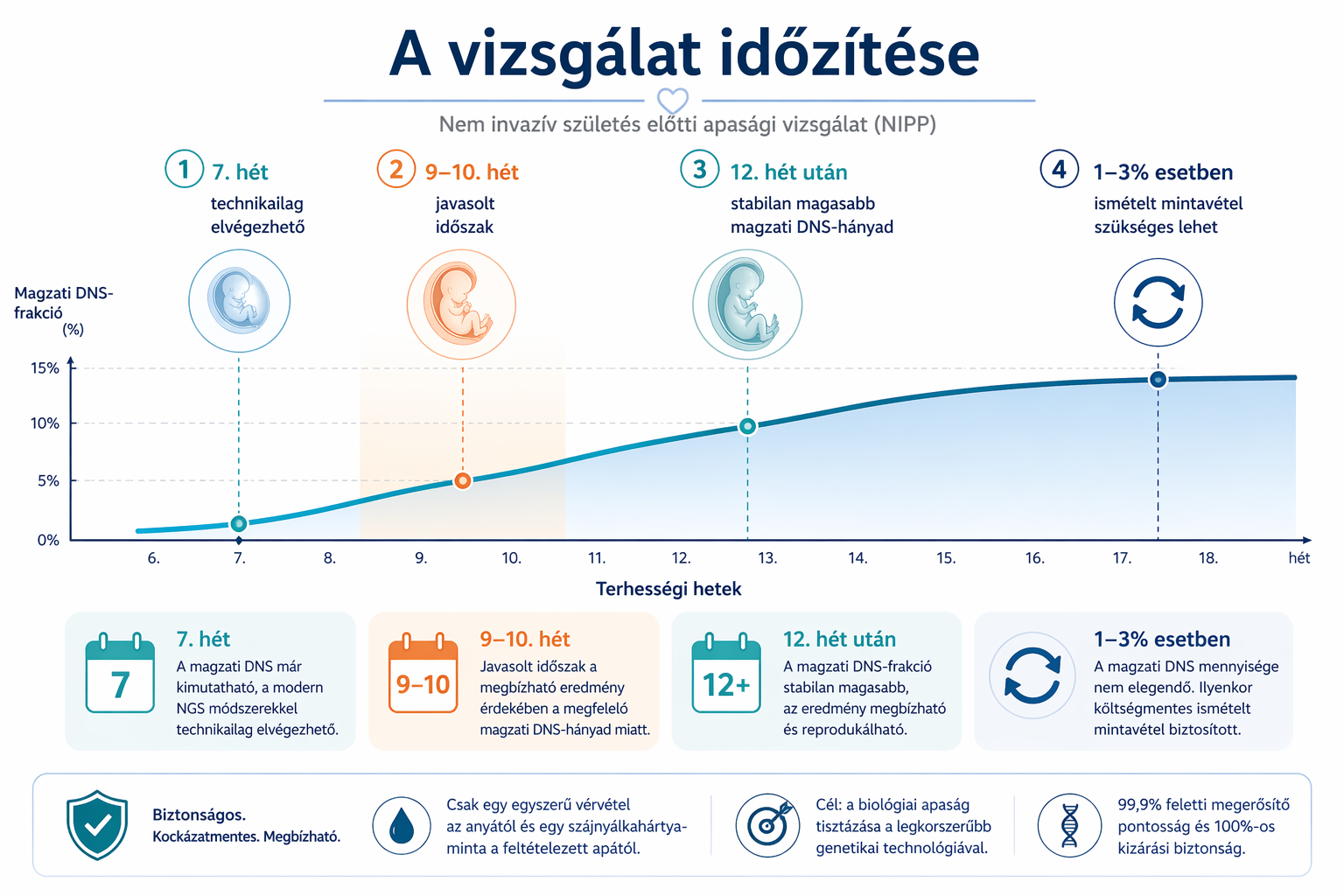
The test is now available from the completed 7th week of pregnancy. From a professional point of view, this is an important threshold, because by this time the proportion of foetal DNA in the maternal blood has generally reached the level at which a reliable result can be obtained using modern NGS panels.
What influences the amount of foetal DNA
The foetal fraction – that is, the percentage represented by foetal-origin DNA within the total cell-free DNA in the maternal blood – is not the same in every pregnant woman. A few factors that have a meaningful influence:
- The week of pregnancy. As a general rule, the foetal fraction rises steadily from week 7 to weeks 10–12, and after 12 weeks it is typically stably sufficient.
- Maternal body mass index (BMI). At higher BMI values, foetal DNA is diluted across a larger circulating blood volume, so the measurable fraction may be lower. In such cases, it is advisable to take the sample after weeks 9–10 to be on the safe side.
- Multiple pregnancy. In twin pregnancies, the structure of the foetal fraction is different; at DNS Központ this therefore requires a separate consultation.
- Individual biological variability. In rare cases – in around 1–3% of pregnancies – the foetal fraction at the time of sampling is below the level required for the test, regardless of how advanced the pregnancy is.
What happens if there is not enough foetal DNA
This is a fair question, and the answer is simple: at DNS Központ, repeat sampling can be arranged free of charge. In our experience, the proportion of cases without a result is between 1% and 3%. In practice, this means that the laboratory flags the low foetal fraction and proposes a new sampling appointment one or two weeks later. This is why it is worth scheduling the test not at the earliest possible date, but rather at a point when the foetal fraction is reliably detectable – in most cases, this means around the completed 9th–10th week of pregnancy.
How accurate and how safe is it
A modern prenatal paternity test is highly accurate. Paternity can be excluded with 100% certainty if the man tested is definitively not the biological father, while in the case of a confirming result the probability is greater than 99.9%. In practice, "exclusion" means that the foetal pattern is incompatible with the alleged father's DNA at several key points – in such cases the result is unambiguous. "Confirmation" means that the inheritance pattern is consistently matching; reports often state that paternity cannot be excluded, but in genetic terms this is a very strong confirming result.
From a safety perspective, this method represents the greatest step forward. For the mother, sampling means a routine blood draw, and for the alleged father a buccal swab. Since there is no intrauterine sampling, there is also no procedure-related risk of miscarriage as there is with invasive prenatal procedures. This is a sharp difference compared with CVS and amniocentesis, where, according to official patient information, a small but real risk of miscarriage – and, rarely, of infection – has to be taken into account.
Non-invasive paternity testing is therefore particularly valuable in situations where the goal is not medical diagnosis but the safe clarification of biological paternity. From the point of view of the mother and the baby, the risk of the procedure is zero – the same risk level as any routine blood draw during pregnancy.
The full process step by step
The process below describes what happens from the initial enquiry to the final report. DNS Központ handles every step discreetly and at a pre-arranged time.
- Consultation and information. As a first step, we make contact by phone or e-mail, clarify the week of pregnancy, discuss whether the test is being arranged for healthcare (non-legal) purposes or for a possible later official procedure, and agree on the details of the sampling. At this point, the client is informed of the expected turnaround time, the cost and the possible types of result.
- Sampling. The maternal blood draw can take place at the DNS Központ office in Budapest or within our partner network, by prior arrangement. The buccal sample of the alleged father is taken at the same location or – if discretion requires – the client can collect it at home with a sterile, individually packaged home sampling kit, following the enclosed instructions. Every sample is handled with an identification code.
- Laboratory analysis. The samples are forwarded to our accredited partner laboratory (Eurofins, Germany / AlphaBiolabs, United Kingdom). The lab performs DNA extraction and then next-generation sequencing. Software-based analysis compares the profiles of the mother, the foetus and the alleged father, and calculates the combined paternity index.
- Communication of results. The report is ready within 7 working days of the samples arriving at the laboratory. The result is communicated discreetly, in a pre-arranged manner – by e-mail, by phone or in person. The written report contains the following: the identifiers of the persons tested, the number of markers used, the combined paternity index, the probabilistic result (confirmation above 99.9% or 100% exclusion), and the laboratory quality assurance references.
Interpreting the result
The report can sometimes be difficult to interpret on one's own, so it is worth briefly considering the types of result you may encounter.
Confirmation (probability greater than 99.9%). If the combined paternity index is high and every genetic marker that could be inherited from the father is present in the foetus, then the result confirms biological paternity in genetic terms. In practice, this means that paternity is established both statistically and at the molecular biology level: the chance of a random match is negligibly small.
Exclusion (100%). If the foetus's genetic pattern contains several markers that cannot have come from the man tested, then paternity can be excluded. This result is not a matter of percentages – it is a matter of genetic impossibility.
Combined paternity index. The number on the report indicating how many times more likely the observed genetic match is than if two random, unrelated individuals were being compared. The larger this number, the stronger the confirmation. In practice, with modern NGS panels this value is typically in the millions or billions.
Legally valid or for information only? This distinction is crucial. A test based on home sampling is just as accurate for personal information, but in administrative proceedings, in court or in a paternity suit only a test based on a witnessed, identity-verified sampling is accepted. DNS Központ provides both versions: which one is needed can be decided during the consultation.
Quality assurance and laboratory background
The professional backbone of DNS Központ is provided by its partner laboratories Eurofins (Germany) and AlphaBiolabs (United Kingdom). Both are internationally recognised forensic genetics laboratories accredited to ISO 17025, processing several million DNA samples each year. The dual laboratory background makes it possible to have a verification option even in the most complex cases.
ISO 17025 is not just a quality stamp, but a detailed operational framework. It prescribes the calibration of equipment, sample tracking (chain of custody), staff qualifications, regular validation of methods, and error-handling protocols. This provides the professional foundation without which no genetic report would stand up to scrutiny, either professionally or legally.
On the Hungarian side, professional responsibility is held by Dr. Attila Bezzegh, head of laboratory and specialist in medical laboratory diagnostics and microbiology, the head of DNS Központ.
NIPP and NIPT – the same or different?
It is worth not confusing these two abbreviations, because in everyday language they are often placed side by side, even though they serve different purposes.
NIPT (non-invasive prenatal testing) is a non-invasive prenatal screening test that examines foetal chromosomal abnormalities, primarily trisomies 21, 18 and 13 (Down, Edwards and Patau syndromes). The sample is the same as for NIPP – maternal blood – and the underlying principle is similar: cell-free foetal DNA. The purpose, however, is quite different: screening foetal health, not clarifying the question of paternity.
NIPP (non-invasive prenatal paternity test) is specifically designed to clarify the question of biological paternity. Although it is performed from the same set of samples – maternal blood and a buccal sample from the father – the laboratory analysis works with different panels and different targeted markers.
The practical implication is simple: if someone is concerned about the foetus's health, they need a NIPT examination (most often as part of antenatal care). If they want to clarify the question of paternity, then a NIPP test is the correct choice. The two tests do not replace each other, but they do not exclude each other either – with some providers, they can even be combined.
The legal framework in Hungary
The question of paternity is not only a biological matter, but also a legal one. The family law provisions of the Hungarian Civil Code (Ptk.) define the system of presumption of paternity: under this, paternity is established in legal terms primarily on the basis of marriage, or a fully effective declaration of acknowledgement of paternity, and ultimately by court ruling. A DNA test does not replace the legal procedure, but provides its objective professional basis.
When is a witnessed test required? In every case where the result will be used in a subsequent official procedure – a paternity suit, the contesting of an acknowledgement of paternity, an inheritance matter, an immigration case or a custody case. The distinctive feature of a witnessed test is that sampling takes place in an identity-verified manner: a member of the DNS Központ team checks identity documents, records the sampling, has the parties sign the documentation, and the entire chain-of-custody process remains documented. Without this, the test is technically just as accurate, but the court will not accept it as evidence, because it cannot be reliably traced back to whom the sample tested came from.
Coded / home-sampled test. This is the faster and more discreet form. The client receives the sampling kit, takes the samples at home and sends them back. The report is just as suitable for personal information, but not for official proceedings. This is not a drawback – they are simply two different services designed for two different purposes of use.
Data protection. The DNA sample and the result qualify as special personal data under the GDPR and Hungarian healthcare data protection regulations. After the test has been performed, DNS Központ keeps samples for the period prescribed by law and then destroys them, and does not make the data accessible to third parties beyond what is professionally indispensable. This is the basis of discretion.
Price, administration, logistics
Exact prices depend on the current service package and are finalised during the consultation, but the main components that make up the fee for a NIPP test are:
- The cost of the laboratory work (this is the main item, including the NGS analysis).
- The cost of sampling (home kit or in-office, witnessed sampling priced separately).
- Expert consultation (interpretation of the result, expert opinion if required).
- Optional items: rush analysis, foreign-language report, expert opinion prepared for court proceedings.
The ordering process typically looks like this: phone or e-mail consultation → quote sent → appointment booking → sampling → lab → report. The full process – from sampling to receipt of the report – is generally completed within 10 working days. At DNS Központ, free domestic shipping and discreet packaging are standard for every home test.
The development of the method
The story began long before today's laboratory automation. Early paternity tests were based on blood groups and other serological markers. These were primarily suitable for exclusion and often did not provide a clear answer. The major turning point came with the appearance of the DNA fingerprint in the mid-1980s: a 1985 publication already described the method as suitable for examining parent-child relationships, and by the end of the decade DNA-based paternity testing had also entered practical use.
The next decisive step took place in 1997, when Dennis Lo and his colleagues described the presence of cell-free foetal DNA in maternal plasma. Subsequent non-invasive prenatal technologies were built on this, and from the 2010s onwards NGS-based systems followed, which allow hundreds of genetic signals to be analysed simultaneously. NIPP today is a mature test that can be performed as a routine procedure and is available in almost every developed country in the world.
The most recent direction of development is the further expansion of panels and the use of machine-learning-based signal processing, which allows reliable analysis even at lower foetal fractions. In practice, this means that the proportion of unsuccessful samplings is steadily decreasing, and within the foreseeable future testing before the completed 7th week is also expected to become routine.
Common misconceptions
"The test is not accurate because of the child's sex." This is not the case. Modern NIPP panels are based on autosomal markers, which are located on the 22 non-sex chromosomes. This means that the child's sex is independent of the test's accuracy.
"The test poses a risk to the baby." The non-invasive test is called this precisely because it involves no intrauterine intervention whatsoever. For the mother it is a routine blood draw, for the foetus nothing at all. This is the fundamental difference compared with invasive prenatal methods.
"It can only be done after weeks 14–16." This was true of older technology. The modern, NGS-based NIPP test can be performed as early as the completed 7th week.
"It's the same as the NIPT Down screening." It is not the same. Although the technological basis is shared (cell-free foetal DNA from maternal blood), the purpose of NIPT is chromosomal screening, while the purpose of NIPP is paternity determination. Two different tests, with two different reports.
"A home test has the same legal value as an in-office one." Unfortunately not. The genetic accuracy of a test based on home sampling is the same, but the sampling is not identity-verified, which is why it is not accepted in administrative proceedings. A witnessed test meets this legal requirement.
"Knowing the biological father automatically changes the official father status." This is also not the case. Under Hungarian civil law, legal paternity is a separate category, which is changed not by a DNA report but by an acknowledgement of paternity or a court ruling. A NIPP test can provide the basis for legal steps, but it does not replace them.
Frequently asked questions (FAQ)
From which week of pregnancy can the test be performed?
From the completed 7th week of pregnancy. The ideal period in most cases is around weeks 9–10, when the amount of foetal DNA is reliably sufficient.
What kind of sample is required?
From the mother, a routine blood sample (one tube) and a buccal swab; from the alleged father, a buccal swab. There is no foetal sampling.
Is the test risky for the baby?
No. Since there is no intrauterine intervention, the test carries no risk of miscarriage or infection for the foetus. For the mother, the risk is the same as that of an ordinary blood draw.
How accurate is the result?
In the case of confirmation, accuracy is greater than 99.9%, and in the case of exclusion it is 100%. This is achieved using internationally accepted, validated NGS-based methods.
How long does it take?
Laboratory analysis typically takes 7 working days from the arrival of the sample. The full process, from sampling to the report, is generally completed within 10 working days.
What happens if there is not enough foetal DNA in the sample?
This occurs in 1–3% of samples. In such cases, sampling can be repeated free of charge, typically 1–2 weeks later, when the foetal fraction is higher.
Can the report be used in a paternity suit or in court?
Only if the sampling was carried out in a witnessed, identity-verified manner. A test based on home sampling is just as accurate, but it is not accepted in official proceedings.
Is the mother's consent required?
Yes. The test is performed from the mother's blood sample, so sampling can only take place with her informed consent.
Is the process discreet?
Yes. DNS Központ handles every sample with an identification code, sampling and the communication of results take place in a pre-arranged manner, and we store data under the strictest GDPR-compliant protection.
What does it mean if the report says: "paternity cannot be excluded"?
In genetic terms, this is a confirming result. Reports are worded in this way because the methodology of genetic testing works on the basis of exclusion and non-exclusion. The accompanying probability value (greater than 99.9%) makes it clear that this is a confirmation.
Can the test be performed without the father's knowledge?
Professionally and ethically this is not advisable, because the informed consent of the alleged father is required for sampling. DNS Központ only undertakes tests where every party involved is aware of the process.
Can it be performed in twin pregnancies?
In a twin pregnancy, the test can be performed, but the methodology and evaluation are more complex. Every twin case requires a separate consultation, where our professional team decides which protocol is appropriate for the specific situation.
Can a DNA test be falsified?
With witnessed, identity-verified sampling and accredited laboratory processing, practically not. Chain-of-custody and quality-assurance protocols are designed precisely to exclude any possibility of manipulation.
What is the difference between DNS Központ and other providers?
The main difference is the dual accredited laboratory background (Eurofins + AlphaBiolabs), 15 years of professional experience, the professional supervision of Dr. Attila Bezzegh, head of laboratory, as well as the fact that we can perform the test for both personal information and legal purposes.
Why choose DNS Központ
- 15 years of professional experience in paternity and kinship DNA testing.
- Dual accredited laboratory background: Eurofins (Germany) and AlphaBiolabs (United Kingdom), both with ISO 17025 accreditation.
- Discreet handling: every sample is managed with an identification code, with GDPR-level data protection.
- Dual usability: witnessed, court-accepted testing or a discreet, home-sampled informational report – according to the client's needs.
- Short turnaround time: within 7 working days of the samples arriving at the laboratory.
- Free repeat sampling if the amount of foetal DNA proves insufficient.
- Hungarian-language consultation, with English- or Serbian-language reports available on request.
Summary
A prenatal paternity test today no longer means a risky, invasive intervention, but a precise genetic comparison between the foetal DNA detectable in the maternal blood and a sample from the alleged father. The significance of the technology lies in the fact that it can reduce uncertainty early, safely and with great accuracy. Modern genetics in this situation is not spectacular, but useful: a reliable tool that helps people see things more clearly where emotions, family dynamics and planning for the future make guesswork too costly.
If you also have questions regarding the test – whether for personal peace of mind or to prepare for a later official matter – please do not hesitate to contact us. We provide discreet consultation, an accurate quotation and a professionally grounded basis for your decision.
Ready for the next step?
Request a discreet consultation or an immediate quotation.
Request a consultation +36 20 373 5580Sources and professional references
- Lo YM et al. Presence of fetal DNA in maternal plasma and serum. Lancet, 1997.
- Jeffreys AJ et al. Positive identification of an immigration test-case using human DNA fingerprints. Nature, 1985.
- Ryan A et al. Non-invasive prenatal paternity testing by SNP array analysis of cell-free fetal DNA. Prenatal Diagnosis, 2013.
- Jiang M et al. A targeted NGS panel for non-invasive prenatal paternity testing based on 861 SNP markers. Forensic Science International: Genetics, 2023.
- ACOG Committee Opinion – Diagnostic and screening tests for fetal aneuploidy.
- Hungarian Civil Code (Act V of 2013), Family Law Book – presumption of paternity.
- GDPR (EU 2016/679) and Act XLVII of 1997 on healthcare data protection.
The above information is for general guidance only; decisions on individual situations are always made on the basis of personal consultation.