
Virtually all of our DNA tests are performed using simple and painless oral swabbing. The swab is similar to the well-known cotton swab. During sample collection, the inner mucous membrane of the oral cavity is rubbed on both sides with two swabs each (four swabs in total). The rubbing collects the loose surface cells of the mucous membrane, which contain the DNA required for the test.
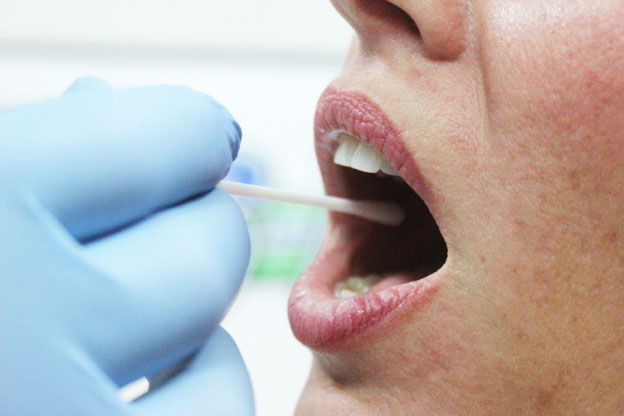
The result of a test performed in this way is completely reliable, and courts may accept the result of such a test at their own discretion. The participating parties may agree in advance to accept the results of a test carried out in each other's presence or in a certified form — in this case the result can be used in proceedings, while costing significantly less than a court procedure and forensic expert opinion. You can be certain that the result of the far more expensive forensic expert opinion will not differ from the test we carry out — provided the samples are taken from the same individuals. The result of our test is in most cases sufficient to clarify the situation and reach a possible out-of-court settlement. After placing your order, we send a sample collection kit. The participants of the test collect the sample themselves by following the simple instructions included in the kit.
The detailed sample collection procedure — illustrating the entire process step by step — is included in the sample collection kit (click here to download in PDF format: Sample Collection Procedure for DNA-Based Genetic Testing). DNA sample collection can practically be carried out at home by anyone with a little care — it requires no special knowledge, activities, or materials; it involves no discomfort or pain; it leaves no trace; and for an inexperienced person it takes approximately 5 minutes per individual, including the time needed to complete the accompanying data sheets.
In a paternity test, samples are collected from at least 2 individuals: the child and the alleged father (the "Duo test"). If a sample can also be taken from the mother (the "Trio test"), the result will be more accurate.
Certified Sample Collection
In the case of a paternity test carried out for official or legal purposes, certified sample collection is required.
During sample collection, the sample must be taken by an independent person (someone who is independent of the participants in the test, has no connection with them, and is in no relationship of dependency or kinship with them). This must be clearly stated in the sample collection documentation and certified by that person's signature as well as the signatures of two witnesses.
Our colleague is happy to carry out the sample collection and handling process; for this purpose an appointment must be made and you must attend our sample collection office. For an additional fee, sample collection can also be carried out at a location of your choosing (including your home).
DNA Sample Collection for Official Purposes
Sample collection intended for use in official proceedings must comply with the relevant regulations. The sample must be taken by an independent person. The sample collection process must be certified by the signatures of two witnesses. As the first step of sample collection, the individuals to be tested must be reliably identified based on their personal documents, and copies must be made of the documents presented for this purpose. A national identity card, passport, or driving licence may be used as documentation. An address card or residence permit must also be presented.
Who Can Carry Out the Certified Sample Collection?
We are happy to assist with this. However, this task — as the sample collection protocol is a private document — can also be carried out with the countersignature of two witnesses by your family doctor, solicitor, guardianship authority officer, or health visitor, among others.
If you request our assistance, you must register in advance and book an appointment. Where possible, all participants should be present at the sample collection at the same time, and it is recommended that the samples be taken in each other's presence. The identity of the sample collector guarantees that no one else can manipulate the collected samples, and that they are submitted intact.
In certain situations, the certification process can in fact be omitted — if the parties in dispute over paternity find a person whom both trust, that person can carry out the sample collection and submission. In this case, they can be spared the additional cost of certification, as they can agree from the outset that both parties will unreservedly accept the result of the test carried out from the samples taken in this way.
Documentation
For certification purposes, the individuals participating in the sample collection must reliably verify their identity. They must therefore present a valid photo ID, a copy of which will be made, and the witnesses must certify that the DNA sample was indeed taken from the person whose details are recorded on the sample container. Reliable chain of custody
After the samples have been taken, it must be ensured that unauthorised persons cannot access them and that the collected DNA samples cannot be tampered with. It is advisable to ensure this by having the person conducting the sample collection personally handle the taking, packaging, and dispatch of the samples, thereby taking responsibility for the reliability of the process and the chain of custody.
The Court Is Free to Decide Whether to Accept the Result of the Certified Sample Collection
Judicial discretion allows the Court to either use or decline to accept the report obtained as the result of a certified and in all respects reliable process. It is important to know that the result of a DNA-based paternity test is a scientifically established fact — meaning it yields the same result upon repetition, provided the samples were taken from the same individuals. Thus, a repeated test ordered due to a potentially rejected paternity report will sooner or later bring the truth to light.
